
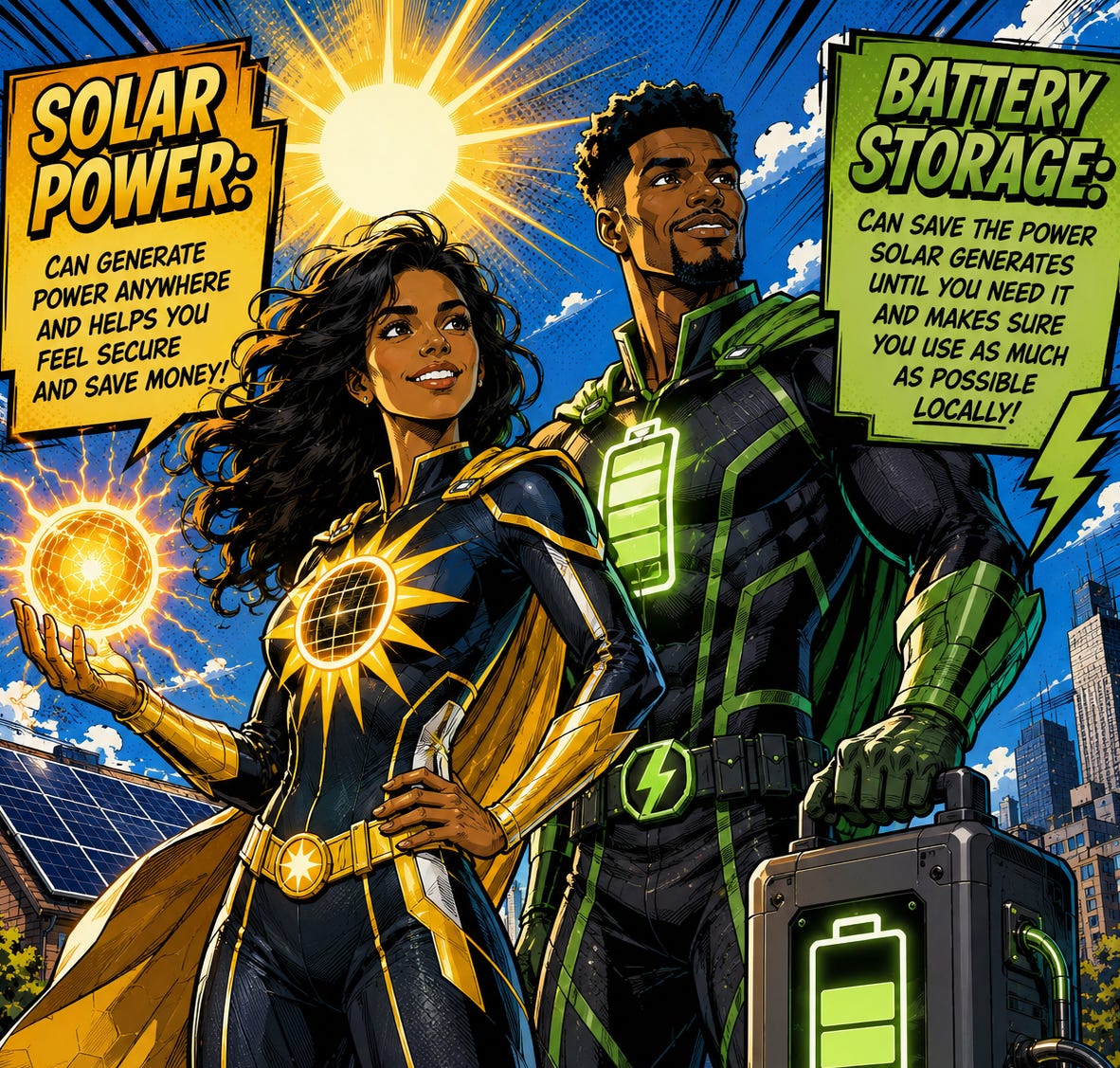
Solar energy has a superpower that is not being used. Coupled with a battery, which helps unleash this superpower, it’s time for the power of the sun to shine in our communities.
Why is electric power big and far away
Throughout its post World War II history, electricity has been seen as something generated far away in large thermal power stations and transmitted over cables to our businesses and homes.
It may not have begun this way. The Edison Electric Light Station at Holborn Viaduct in London, a coal-fired plant and the first of its kind, began generating in 1882 and provided power to its immediate neighbourhood.
But burning coal, oil and gas to generate electricity isn’t very neighbourhood-friendly and, to achieve scale, needed to be located close to large sources of water and railway lines to bring in the fuel. The national grid and our system of electric power developed around this top-down, centralised technology of the day.
Electricity just arrives in our homes. It’s something close to magic, or as certain as gravity. It’s just there when we need it, though the simplicity of turning on a light switch masks a wildly complex market that includes thousands of miles of cable, a sophisticated level of coordination, thousands of trades and tens of thousands of people doing their jobs.
Solar Energy’s Superpower
Back to solar’s superpower (and its companion battery storage, which unleashes solar’s greatness).
The first solar cell was actually created around the same time as Edison’s first power station was swinging into action. Solar as we know it didn’t arrive until the 1950s. Its efficiency has improved a lot since then, but its superpower has remained constant.
Solar - unlike any other form of power generation - does not require fuel or a grid connection to be effective, it does not have to be near water or in a windy area, can be put almost anywhere at almost any scale and power almost anything. For instance, if I can afford the upfront costs (I’ll come onto that) I can put solar on the roof of my home and use the power it generates directly.
And now it’s cheap and efficient and can be paired with a battery, the potential for us to unleash this universal, direct benefit is suddenly extremely high. But it’s not being used.
Lots of small equals big
As my colleague Danny Kennedy has eloquently outlined over on his ProElectrica Substack, a lot of small can result in something big.
In his fabulous ‘The Swarm We Can’t See’ post, he argues that all the krill in the southern ocean outweigh all of the whales. But we focus on the whales because we can’t see the krill. This is probably why we’re overlooking solar’s super power, because panel-by-panel (krill-by-krill) it doesn’t look like much.
And frankly, in the UK, there isn’t that much. Rooftop solar is growing fast at the moment largely due to the force of logic. Gas prices are volatile and have been at the root of recent energy price spikes. The conflict in Iran is seemingly without end. People understandably want to feel secure as well as able to predict their energy bills. Investing in solar - and battery storage - makes sense.
Those who can are. If you have around £10k in your bank account and a good roof space, you can put up panels and install batteries that will save you hundreds on energy bills per year, pay back quickly and mean that in summer months, you’re more than self sufficient in power.
But after years of rising costs and stagnating wages there are lots that can’t. Plus those who live in apartments or rent or don’t have suitable roof space. Plug in solar is on its way, though we won’t be able to buy plug in batteries to accompany our balcony panels so we cannot maximise their benefit.
The current boom among household is boosting our relatively low levels of solar power in the UK, but at probably around 25GW installed, we’re miles behind Germany, which has more than 120GW of installed solar. Plus most of our solar is in large, ground mounted systems (these are important and offer very cheap power but repeat that large things far away fallacy of our power system). Most of Germany’s solar is rooftop.
Back to Danny’s blog. He focuses on Pakistan, where an unreliable power grid and the nation’s close relationship with China has led to a huge household solar boom. The krill are taking over the ocean. In the UK, we’ve focussed on replacing big solar thermal plants powered by coal and gas with big renewables, mostly offshore wind.
That’s not a bad thing; thus far necessary. But we’re getting to the point where we can’t use all of the power we’re generating and the next phase of upgrades to the grid that this top-down approach requires is eye-wateringly expensive. We need more krill.
Unleashing solar’s superpower
The government’s Warm Homes Plan includes some funding for solar and theoretically battery storage in social and privately rented homes as well as low or no cost loans for owner-occupiers. This is an extremely important and valuable step. Those who can’t raise the capital should not have to forgo the considerable benefits.
If we’re ambitious, and recommend (or even require) battery storage to accompany every solar installation (as well as lots of retrofitting of batteries to existing solar, as they’ve been doing in Australia, to great effect) then perhaps as much as one-quarter of the nation’s power needs can be generated and used locally.
There will be a huge temptation for the newly led government to water-down or reduce the budget for the Warm Homes Plan; that would be huge mistake.
Because the aim should be the opposite; to use public investment and to mobilise private capital at scale to drive a solar and battery boom in every postcode. It means households, businesses and institutions can take control of their power and significantly reduce their costs.
Early research also suggests that investing in unleashing solar’s super power could also save some of the planned investments in the power grid, which given their controversy as well as cost, comes with considerable political interest.
One very significant, missing bit of the equation is bringing solar’s super power and the assistance of battery storage to much loved and very significant local institutions. One brilliant example is the revolution underway at the Ravens Rugby Football Club in Bridgend, where there are plans to fully equip the stadium, and dramatically cut the club’s crippling energy bills; effectively to turn the club into a local power station. The stadium is now even called The Electric Brewery Field.
Every village, town and city - every postcode - can become a power station in this way. From Midlothian to Makerfield and Bridgend to Bridport, unleashing the super power of solar can put power into people’s hands.
Let the sunlight shine…
I know what you’re thinking. Great, but … ooh cost and … ooh China and … ooh really solar in the UK?
We have to invest to save. As this summer has demonstrated, we cannot slow down but must speed up efforts to tackle climate change. But investing in solar and batteries (essentially for everyone)n isn’t only or even mostly a climate strategy.
It’s about energy security - it’ll help release us from imports of gas far more effectively the drilling the last few cubits out of the North Sea. And because it’s advantageous, though public investment is needed as a cornerstone, there’s an ocean of private finance just waiting to support the krill.
On China; well, we’re stuck with that for now. Chinese production has made solar and battery cheap and that’s a gift for now. Plus PV panels and batteries are largely benign and unlikely to be insecure. But part of unleashing solar’s superpower should be a thorough go at bring some elements of production to the UK - especially on batteries which are going to be the strategic asset of the age - and using the world-leading innovation of UK institutions.
It’s also about where we want power and control to lie. The investments we’ve made in updating and securing our energy system so far have largely benefitted large energy firms, though there are savings coming our way in the next few years. The nub of solar’s super power is it completely turns this on its head, bringing direct benefits to homes, business and communities.
… in every postcode
If Andy Burnham wants growth in every postcode, then he should also want power in every postcode. Putting money into people’s pockets and boosting small businesses and key local institutions by unleashing solar’s super power and battery storage’s support is growthy and a boost on cost-of-living.
Amp up the Warm Homes Plan, don’t water it down. Work with brilliant organisations such as the Green Finance Institute and Electrify Britain to drive private investment into local solar. Get round the Number 10 North cabinet table with mayors and get them on board. Develop a Power in every Postcode strategy.